
The Plantaris: the Calf’s Quiet Observer
- Paulius Jurasius

- Jan 30
- 3 min read
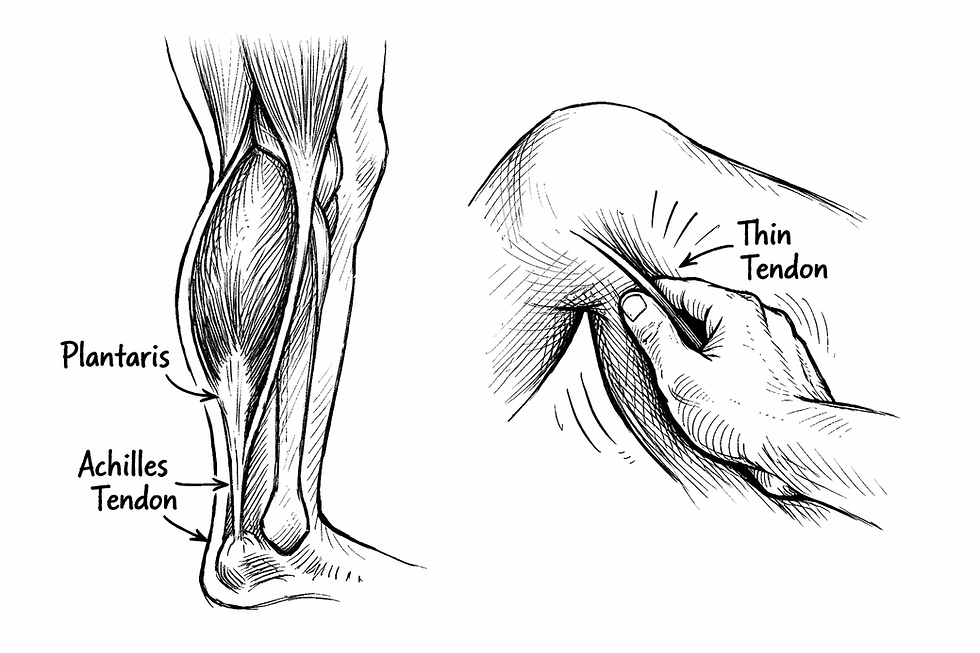
If the calf had a social life, gastrocnemius would be the loud friend who arrives first, soleus would be the reliable one who stays late, and plantaris would be the introvert in the corner—small, polite, and somehow always involved when something mysterious happens.
Most people never hear its name. Yet the plantaris has a habit of showing up in conversations about odd calf twinges, Achilles irritation, and that annoying “something’s not right” feeling behind the knee.
What it is (in plain anatomy)
The plantaris is a tiny muscle in the back of the leg. It usually starts above the knee (near the outer side of the femur) and sends a long, thin tendon down toward the heel—often running close to the Achilles tendon before attaching near the calcaneus.
And here’s the fun part: some people don’t have it at all. Nature occasionally deletes it like an old app and your body carries on, completely unbothered.
So yes—this muscle is optional. Which makes it even more interesting.
Why would nature keep a “spare” muscle?
In the JANMI way of thinking, muscles aren’t only engines—they’re messages.Even the small ones can act like sensory storytellers, reflecting how you walk, brace, sprint, sit, and protect yourself when life gets a bit too modern.
Plantaris doesn’t contribute much power. But it sits in a strategic place:behind the knee, near the calf, close to the Achilles… right where strain, speed, and stress often meet.
It’s a quiet observer—yet it’s positioned like a sentry.
The modern calf problem
In clinic (Marylebone or anywhere with pavements and deadlines), many legs live in two extreme modes:
Sitting for hours (calf asleep, ankle stiff, nervous system bored)
Sudden heroics (a run, a class, a sprint for the bus, a “quick” game of tennis)
The calf complex hates surprises. And the plantaris—because it’s slender, long-tendoned, and close to big structures—can become part of the drama when the system transitions too quickly.
Sometimes the sensation people describe isn’t “pain” exactly. It’s more like:
a sharp little flick behind the knee
a stringy tightness deep in the calf
a localised sting near the Achilles that doesn’t match the size of the problem
Small structure, loud signal. Classic body logic.
JANMI touch perspective: listening for the thin thread
Plantaris is not a muscle you “attack.” It’s one you meet.
In hands-on work, subtle tissues often respond best to subtle contact. Not because the tissue is fragile—more because the nervous system is already vigilant there.
So the question becomes:
What happens if the therapist’s hand approaches plantaris like a conversation, not a conquest?
Gentle contact, clear attention, and patient listening can change the tone of the whole calf. The big muscles often follow the small ones—like a crowd relaxing when the anxious person finally exhales.
And that’s the point: sometimes the most effective touch is not the strongest. It’s the most intelligent.
A tiny reflection to take with you
Plantaris reminds me that the body keeps strange little details for a reason.Not everything in you is designed for performance. Some parts are designed for awareness.
And modern life doesn’t only weaken muscles. It can dull the ability to notice them—until they shout.
So if your calf ever feels like it’s holding a secret, consider this:
Maybe it’s not broken.Maybe it’s communicating.
Closing line: Sometimes the smallest muscle isn’t trying to cause trouble—it's trying to restore your attention.


Comments