.png)
The Three Modern Postural Habits That Secretly Create Sciatica

My dear reader,
If you have ever felt that familiar lightning bolt of pain travelling from your lower back into your glute, then down the hamstring as if someone plugged your leg into an electrical socket, you have experienced sciatica — the modern body's polite way of saying:
“Excuse me… you are living in a posture your spine did not sign up for.”
Sciatica is not a random villain that attacks people for fun.
It is a mechanical story, a fascial story, and increasingly — a modern lifestyle story.
Today, I want to show you the three postural habits I see most often in my Marylebone clinic that create the perfect storm for sciatica.
And trust me… if early humans could see how we sit, stand, and walk today, they would probably drop their stone tools in disbelief.
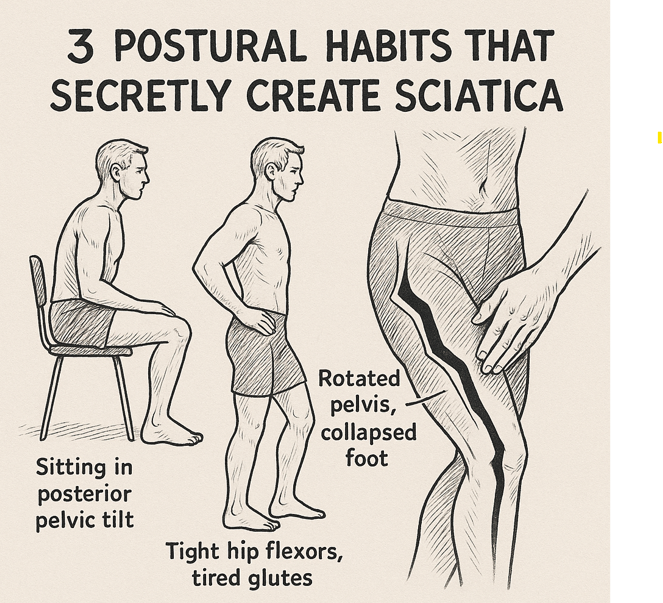
1. THE “CHAIR-SHAPED HUMAN” HABIT — SITTING IN POSTERIOR PELVIC TILT
There is sitting… and then there is sitting like your pelvis has given up on life.
Modern chairs encourage a posterior pelvic tilt (PPT) — the pelvis tucks under, the lumbar curve flattens, and the sacrum becomes a weight-bearing structure instead of a stabilising one.
Biomechanically, this habit:
compresses the lumbar discs
overstretches the spinal erectors
tightens the piriformis
weakens the deep core
jams the SI joint
increases pressure on the sciatic nerve
This is the birthplace of “sciatic irritation.”
Evolutionarily speaking?
We were designed to squat, walk, run, climb, carry, sit on the ground, stand, move.
But not to sit on soft chairs for 6–10 hours a day while our pelvis slowly morphs into a sad crescent moon.
The sciatic nerve pays the price for a posture our ancestors never knew existed.
2. THE “TIGHT HIP FLEXOR, TIRED GLUTE” HABIT — ANTERIOR PELVIC TILT FROM MODERN LIFE
This is the opposite posture to habit #1 —
and equally problematic.
Anterior Pelvic Tilt (APT) happens when:
psoas becomes chronically shortened
iliacus tightens
lower back overarches
glutes stop doing their job
hamstrings become confused emotional creatures
the pelvis tilts forward like a bucket spilling water
This creates lumbar compression and sciatic nerve irritation.
Modern triggers include:
long sitting
long driving
running without mobility work
gym workouts with no posterior-chain balance
stress, which tightens the psoas even more
Here’s the poetic irony:
The psoas tightens from modern emotional and physical load… and the sciatic nerve becomes the messenger of that silent tension.
Humans were meant to walk for miles each day.
Instead, we now sprint occasionally, sit endlessly, and wonder why our hips feel like concrete slabs.
3. THE “ROTATED PELVIS, COLLAPSED FOOT” HABIT — WHEN GAIT IMBALANCE TAKES OVER
If there is one thing the sciatic nerve despises, it is asymmetry.
And modern humans are wonderfully, beautifully, catastrophically asymmetrical.
The most common pattern?
one foot collapses inward
knee valgus appears
hip internally rotates
pelvis rotates
lumbar vertebrae compensate
piriformis becomes overworked
sciatic nerve becomes grumpy
This creates a torsional load — a spiral tension that winds the pelvis like a rope.
The result?
A sciatic nerve under tension, stretch, or compression depending on the pattern.
Evolutionarily, our feet were meant to walk on:
soil
sand
uneven forest ground
stones
grass
slopes
textures
Instead, we walk on:
tiles
concrete
tarmac
flat shoes
treadmills
The foot collapses. The hip rotates. The pelvis twists. The nerve complains.
THE FASCIAL REASON ALL THREE HABITS CAUSE SCIATICA
The sciatic nerve is not a lonely structure.
It lives inside a fascial envelope connected to:
gluteus maximus
piriformis
deep hip rotators
hamstring fascia
thoracolumbar fascia
diaphragm tension
even the feet
Fascia LOVES balance.
Fascia HATES chronic asymmetry.
When posture changes, fascial tension pulls the nerve along for the ride.
This is why sciatica is not just a “back problem” — it is a whole-body pattern.
WHY JANMI INTEGRATED THERAPY TREATS SCIATICA SO EFFECTIVELY
Because we treat:
✔ The root patterns
(PPT, APT, rotation, fascial compression)
✔ The fascial lines
(posterior chain tension, deep hip fascia, foot mechanics)
✔ The trigger points
(glute med/min, piriformis, QL, hamstrings)
✔ The deep influencers
(psoas, diaphragm, thoracolumbar fascia)
✔ The nervous system
(breathing resets, calming input)
We don’t chase nerve pain. We remove the reason the nerve is irritated. This is why clients often say after a session:
“It feels like someone unwound my spine.”
Because that’s exactly what we do.
A FINAL NOTE FROM ME
Sciatica is not a curse. It is a conversation your nervous system is trying to have with you.
It says:
“You are living in a posture your body did not evolve for.”
And the good news?
With the right touch, intention, mobilisation, and awareness, your body remembers its natural alignment faster than you think.
Warmly,
Paulius


Comments