.png)
The Muscle Designed to Hold Us Together — and Why It Falls Asleep Today

My Dear Reader,
There is a muscle I rarely need to point out on a chart, because most people feel its absence rather than its presence.
It’s the transversus abdominis — often called the deepest abdominal muscle — and at JANMI Postural Pain Clinic in Marylebone, it is one of the most common sleepers we encounter in modern postural pain.
What is the transversus abdominis?
Anatomically, the transversus abdominis (TrA) wraps around the abdomen like a wide belt.Its fibres run horizontally, attaching to the ribs, pelvis, and thoracolumbar fascia.
It does not flex the spine.It does not create visible “core strength”.
Its role is far more subtle:
stabilising the lumbar spine
managing internal pressure
coordinating with the diaphragm and pelvic floor
preparing the body for movement before it happens
When it works well, movement feels organised and safe.When it goes quiet, other tissues step in to protect.
Why does it fall asleep in modern bodies?
Modern life has changed how we use our bodies — not for the worse, but for the narrower.
We sit more than we walk.We brace instead of move.We isolate muscles instead of integrating them.We train “core strength” in short bursts instead of living inside it all day.
The body adapts.
The transversus abdominis underperforms, while:
superficial abdominals grip
hip flexors overwork
lumbar extensors brace
breathing becomes shallow
Once again, the JANMI pattern appears:sleeping stabilisers + overworking guards.
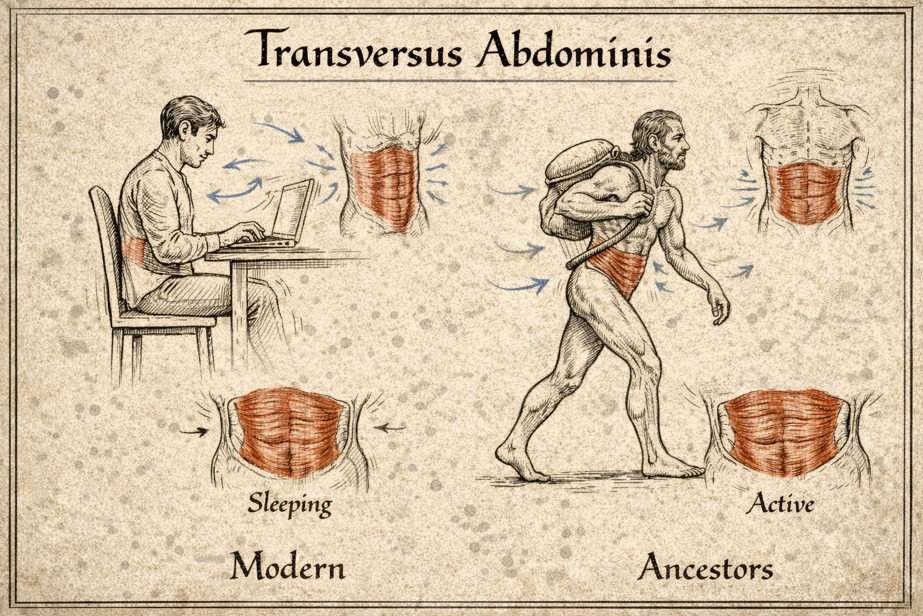
A look back: modern humans vs our ancestors
Our ancestors did not “train core”.
They:
walked long distances
carried loads close to the body
changed direction frequently
breathed deeply while moving
The transversus abdominis was used constantly, quietly, and reflexively.
In contrast, modern humans often:
sit with passive support
move in straight lines
hold breath under stress
switch posture on only when reminded
The muscle designed for continuous, low-level support is asked to wake up only during exercises — and then blamed for being weak.
Where this shows up clinically
A sleeping transversus abdominis often hides behind:
persistent lower back pain
pelvic instability
hip tightness
SI joint irritation
feeling “unsupported” through the middle
The danger is not lack of strength.It’s loss of timing and coordination.
The JANMI focus
At JANMI, we don’t chase “core strength”.
We restore coordination.
We look at:
how breathing and pressure are managed
whether the TrA responds before movement
how it cooperates with diaphragm, pelvic floor, and hips
Only then do we introduce short, precise, bodyweight-based reactivation drills — often invisible to the untrained eye, but deeply effective.
Not more tension.Better organisation.
A note on exercises
Yes, there are effective ways to wake the transversus abdominis — but forcing it, bracing hard, or over-cueing often makes things worse.
At JANMI, reactivation is:
subtle
breath-led
pain-free
integrated into real movement
A quiet closing thought
Your body doesn’t need a stronger centre.It needs a listening one.
Warmly,Paulius Jurasius
JANMI Soft Tissue Therapy, Marylebone


Comments